
September 25, 2026
Distribution Pipeline Construction: What It Is and Where It Fits
Distribution pipelines carry gas the last stretch to homes and businesses. What distribution construction involves and how it differs from transmission work.
Key takeaways
- A distribution pipeline is the smaller, lower-pressure pipe that carries gas the last stretch from a transmission system to where it is used.
- Distribution work usually means tighter rights-of-way: streets, yards, and other utilities already in the ground, not open country.
- The build follows the same sequence as any pipeline job. Distribution work just runs that sequence in tighter quarters, block by block.
- Tie-ins connect a new distribution main into a live system, and that connection is one of the more exacting steps in the work.
- A contractor that runs both transmission and distribution with the same crews carries the standard of work across every job size.
An engineer at a gas utility spends months lining up a transmission tie-in for a new industrial account, then gets asked to scope the distribution main that will serve three new residential streets going in behind it. Both projects sit on the same map and get built by the same trade, but the bid that comes back for the distribution work reads nothing like the transmission quote, and the difference is not padding.
That question comes up often enough that it is worth answering plainly. Transmission and distribution pipeline construction are the same trade doing different jobs, in different settings, at different scales. If you have only ever priced the big mainline work, distribution deserves to be understood on its own terms rather than treated as a smaller version of the same thing.
The build itself follows the same stages any pipeline goes through, but distribution work runs those stages in tighter quarters, closer to people, and closer to other utilities that were put in the ground by somebody else on a different schedule. That difference is most of what drives the cost, the pace, and the coordination on a distribution job.
What makes a pipeline “distribution” instead of “transmission”
A transmission pipeline is the long-haul, large-diameter, higher-pressure part of the system, the kind of work covered on our large-diameter and cross-country page. Distribution pipe is what steps down off that system. It runs at lower pressure, in smaller diameters, and it is what actually reaches a customer: a subdivision, a commercial strip, or a facility getting gas service for the first time.
Every foot of transmission pipe exists to move product long distances efficiently. Every foot of distribution pipe exists to get product the last, shorter distance to where somebody is going to use it. Both jobs matter to the system. They are just built for different purposes, and that purpose shapes almost everything else about how each one gets constructed.
The distinction shows up in the pipe itself. Distribution mains and services are typically smaller in diameter and run at pressures the local system is designed to handle, and depending on the application and the code requirements, the pipe can be steel or a plastic material suited to that pressure class. Transmission pipe, by contrast, is almost always steel, sized and rated for the higher pressures and longer runs the mainline system carries. Neither choice is better. Each is matched to the job the pipe has to do.
Why distribution work looks different on the ground
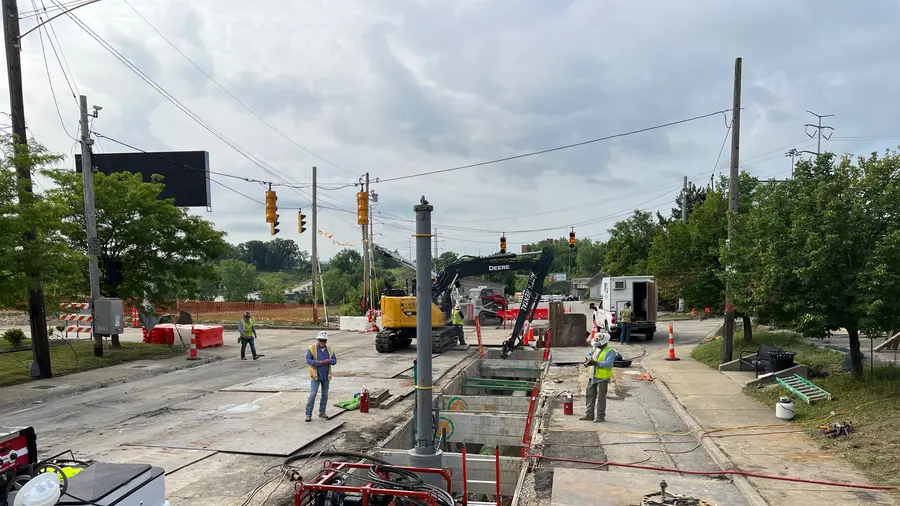
Transmission work often runs across open country, following a right-of-way that was cleared and permitted for exactly that purpose. Distribution work runs through streets, alongside sidewalks, across yards, and next to water lines, sewer lines, and electric conduit that were installed by other people on other schedules entirely. The working space is narrower, the neighbors are closer, and the margin for error around what is already underground is smaller.
That changes the pace and the planning. A crew on a distribution job spends real time locating and protecting existing utilities before a spade ever touches the ground, and traffic control and property access add steps a cross-country transmission crew rarely has to think about. None of this makes distribution work harder than transmission work. It makes it a different kind of demanding, one that rewards a crew that has already done it and knows where the friction usually shows up.
It also changes how much a crew has to communicate with people who are not part of the project. On a transmission right-of-way, the people you deal with are mostly landowners along the route. On a distribution job, it is homeowners backing out of driveways, businesses that need their entrance kept open, and a city or county that has its own rules about how long a street can stay torn up. Restoration matters just as much here as it does on any right-of-way, but on a distribution job the standard people notice is the yard, the sidewalk, and the pavement patch in front of their own house, not a graded field they will drive past once.
The same sequence, run in tighter quarters
Strip away the setting and a distribution job follows the same sequence as any pipeline: clear the path, string and bend the pipe, weld it, inspect and coat the joints, lower it in, backfill, test it, and restore the surface. What changes is the scale of each step. Instead of a crew stringing pipe for a mile across a field, a distribution crew might lay and weld a few hundred feet of smaller-diameter pipe down one residential block, then pick up and move to the next.
That smaller scale can fool people into underestimating the coordination it takes. A short distribution run through an occupied street often has more stakeholders per foot than a long transmission run through open country, even though the pipe itself is easier to handle. Keeping traffic moving, keeping driveways accessible, and keeping every other utility in the ground undisturbed takes as much planning as the welding does.
The equipment on site usually looks different too. A transmission spread runs sidebooms, large excavators, and pipe-handling equipment sized for large-diameter pipe moving across open ground. A distribution crew more often runs smaller excavators, trenchers, and directional boring equipment sized for shorter runs and narrower cuts, because tearing up an entire street when a bore under it would work is neither necessary nor welcome. Matching the equipment to the setting is part of what keeps a distribution job efficient instead of disruptive.
Tie-ins are where distribution work gets exacting
A new distribution main rarely stands on its own. It has to connect into an existing system, and that connection point, the tie-in, is one of the more exacting parts of the job. Getting a tie-in wrong risks an outage or a safety issue on a system that is already serving customers, so the fabrication and tie-in work has to be planned and executed with the same discipline as any other pressure-carrying joint on the line.
Coordinating a tie-in also means coordinating with the operator’s own schedule, not just the construction crew’s. The window to connect into a live system is often short, and a contractor that self-performs the fabrication and the tie-in, rather than handing it to a sub, has fewer hand-offs to manage inside that window.
Some tie-ins can be made without interrupting service to existing customers, using methods designed to connect into a pressurized line safely. Others require a planned, temporary shutdown of a section of the system, timed and communicated well in advance. Either way, the crew making the connection has to know exactly what is on the other side of that joint before they ever cut into it, which is why tie-in work sits at the more careful end of distribution construction rather than the routine end.
Who is actually buying distribution work
Most distribution construction gets bought by gas utilities and midstream operators extending service to new customers, whether that is a subdivision, a commercial development, or an industrial account tying in for the first time. We have written before about what that market looks for in a contractor for gas utilities and midstream work, and distribution scope is a regular, recurring part of that relationship. It tends to be steadier work than the occasional large transmission project, because service areas keep growing and existing systems keep needing extensions and upgrades.
There is also a reinforcement side to distribution work that has nothing to do with new customers at all. As a service area grows or an older section of main reaches the end of its useful life, an operator will replace or upsize distribution pipe just to keep pressure and capacity where the system needs it. That kind of project rarely makes the news, but it is a steady part of what keeps a gas system reliable, and it calls for the same distribution skill set as building new main into a subdivision.
Why one contractor for both is worth asking for
Some contractors specialize in one side of this or the other, and that can work fine. But a contractor comfortable on both transmission and distribution brings something real to the table: the same crews, the same safety standards, and the same self-performed approach to running a spread, regardless of whether the job is a cross-country mainline or three blocks of residential main. The fundamentals of welding, coating, testing, and restoration do not change with the diameter of the pipe.
That consistency matters most to a utility or operator managing a mix of project sizes over the course of a year. Instead of maintaining separate contractor relationships for big transmission builds and everyday distribution extensions, one capable contractor can carry both, which simplifies vetting and keeps the standard of work the same across the whole system.
If you have a distribution scope coming up, whether it is a single tie-in or a season’s worth of extensions, get in touch and tell us what you are planning. We will give you a straight read on what it takes and how we would crew it.
Frequently asked questions
What is a distribution pipeline?
A distribution pipeline is the smaller-diameter, lower-pressure pipe that steps down off a transmission system and carries gas or other product the final distance to where it is actually used, such as a subdivision, a commercial development, or an industrial customer.
How is distribution pipeline construction different from transmission construction?
Transmission work usually runs across open country on a right-of-way cleared for that purpose. Distribution work usually runs through streets, yards, and easements alongside other utilities already in the ground, so the crew deals with tighter working space, more crossings, and more coordination with property owners and traffic.
Does building a distribution line follow the same steps as a transmission line?
Yes. Both go through clearing, stringing, welding, coating, lowering in, backfill, testing, and restoration. Distribution work runs that same sequence at a smaller scale and in more confined settings, which changes the pace and the planning more than the fundamentals.
What is a tie-in on a distribution pipeline?
A tie-in is the connection point where a new distribution main joins an existing, often live, pipeline system. It has to be planned and executed carefully because a mistake at that connection can affect service to customers already on the system.
Does Appalachian Pipeline build distribution pipelines?
Yes. We build both transmission and distribution pipelines with our own self-performed crews, for natural gas, oil, and refined products, scaling the spread to whatever the job needs.