
June 9, 2026
What a "Spread" Means in Pipeline Construction
Pipeline capacity is measured in spreads and crews, not diameter or mileage. What a spread is, and why it matters when you pick a contractor.
Key takeaways
- A spread is the full assembly line of crews working a section of right-of-way, from clearing and grading through welding, lowering-in, and restoration.
- Real capacity is measured in spreads and crews, not the diameter of the pipe or the miles on the map.
- Stacking a 20-mile job and a 60-mile job is the same work in the same order. The longer one just runs longer.
- Ask a contractor how they would crew and stack your specific job. That answer tells you more than any mileage number.
We hear the same worry all the time. A developer looks at a privately owned contractor, decides it looks too small for the line they are planning, and almost moves on. Then they ask how the job would actually get built, and the conversation turns. What decides whether a contractor can handle your line is not its size on paper. It comes down to one word that almost nobody bothers to explain: the spread.
People outside the industry tend to size up a pipeline contractor by the diameter of the pipe or the miles on the map. That is not how capacity works, and if you are hiring one for the first time, it is worth understanding why before you compare a single bid. Once you know what a spread is, a lot of the noise around contractor size falls away, and you can judge the thing that actually matters.
What a spread actually is
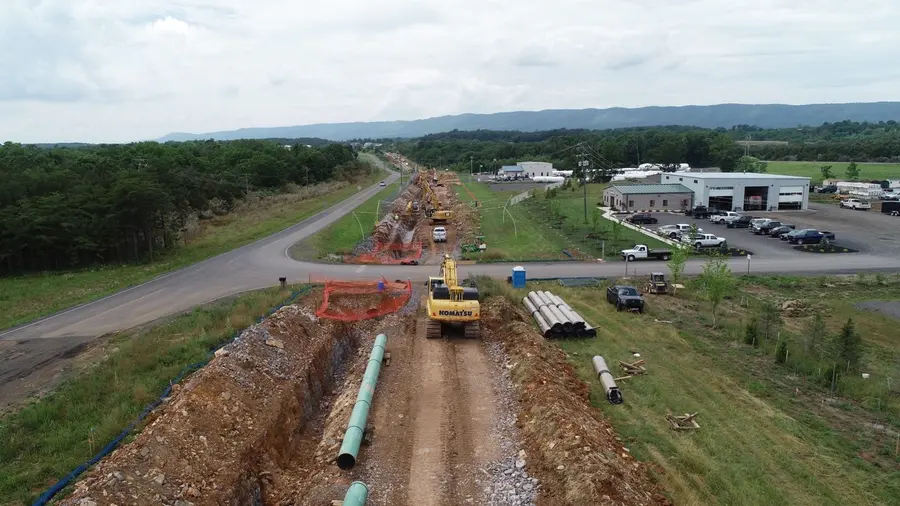
A spread is a complete construction operation working a section of right-of-way. Picture the full assembly line moving down the route: the crews clearing and grading, the crews stringing and bending pipe, the welders, the inspectors, the crews lowering the line in and backfilling, and the crews restoring the land behind them. It is one coordinated operation that moves across the ground like a slow, deliberate machine, and every part of it has to keep pace with the rest.
The word gets used loosely, so it helps to be precise. A spread is not a single crew and it is not the whole company. It is the organized group of crews and equipment assigned to build a stretch of line from front to back. On a bigger job you might run more than one spread at the same time, each working its own section, which is how a long line gets built without simply taking twice as long. Every one of the stages in a pipeline build is a crew working inside that spread.
One spread might be two crews or it might be ten, depending on the job. That is the real unit of capacity, and it is the honest way to measure whether a contractor can handle your project.
The crews that make up a spread
To see why size on paper is misleading, it helps to look at what is actually inside a spread. The work moves in sequence, and each step is its own crew with its own skill set.
- Clearing and grading crews open and prepare the right-of-way so equipment can work safely.
- Stringing and bending crews lay the pipe out along the ditch and shape it to the terrain.
- Welding and inspection crews join the pipe into one continuous line and check every weld.
- Lower-in and backfill crews set the welded line into the trench and cover it back over.
- Testing and tie-in crews prove the line holds pressure and connect it into the system.
- Cleanup and restoration crews put the land back the way they found it.
The point is not the list. It is that a spread is a chain of specialized crews that has to stay balanced. If the welders get ahead of the ditch, or the coating crew falls behind the lower-in, the whole operation slows down. Running a spread well is mostly about keeping that balance, which is a management skill, not a function of how large the company looks in a brochure.
Why mileage alone misleads you
Here is the part that trips people up. Stacking a 20-mile job and a 60-mile job is the same work. You line up the same crews in the same order, and the longer job just runs longer. The sequence does not change because the line got longer. You are still clearing, stringing, welding, lowering in, testing, and restoring, in that order, one section after another.
So when someone asks whether a contractor is big enough for a 60-mile line, the honest answer has nothing to do with a number on a brochure. It has to do with whether they can field and run the crews and superintendents to keep the spread moving. That is a question about people and management, not about size. A contractor that runs a tight spread on a 20-mile job is showing you exactly the ability that matters on a longer one.
How a job actually scales
When a line is long enough or the schedule is tight enough, you do not build one endless spread. You add spreads. Each one takes a section of the route and runs the same sequence, and the superintendents coordinate where the sections meet. That is how capacity really grows in this business: not by owning a warehouse full of idle equipment, but by being able to organize and staff more crews and keep them moving in step.
This is also why self-performing the work matters so much. When the crews on the spread are your own, you control the pace directly. When large parts of the spread are subcontracted, every hand-off between subs becomes a place where the balance can break down, and the schedule slips in the gaps. A contractor that self-performs across the scope has fewer seams to manage and more direct control over the tempo of the job.
What this means when you compare contractors
This is exactly why we tell people not to rule a contractor out for being privately owned or for not being one of the publicly traded giants. We scale spreads and crews to the project, because we can build and run the spreads to do it, and staying privately owned keeps the people making decisions close to the work. When a question comes up on the spread, the answer does not have to travel up five rungs of a corporate ladder before it comes back.
A contractor who can walk you through how they would stack your specific job, crew by crew, has actually thought about your project. One who just quotes a mileage range has not. Ask them how many spreads they would run, how they would sequence the crews, and how they would keep the operation balanced. Those are the questions to ask before you sign, and the answers tell you far more than the size of the logo on the truck.
What a well-run spread looks like on the ground
If you ever get to walk a job, a healthy spread has a certain rhythm to it. The clearing and grading is well ahead, the pipe is strung and waiting, the welders are moving at a steady clip, and the lower-in crew is close enough behind that the open ditch is never sitting exposed longer than it needs to be. Nothing is racing, and nothing is stalled. That steadiness is not luck. It is a superintendent who knows how to read the whole operation and shift people and equipment before a gap turns into a delay.
A struggling spread looks different. One crew is standing around waiting on another, the ditch is open too far ahead of the pipe, or the welders are stacked up because the coating crew fell behind. Every one of those is a balance problem, and balance problems cost days. This is the real work of running a spread, and it is exactly the skill you are trying to judge when you hire. It has very little to do with how big the company is and everything to do with how well it runs the crews it puts on your line. A contractor that self-performs across the scope has the most direct control over that rhythm, because the crews answer to the same people who made you the schedule.
The short version
A spread is how pipeline gets built, and it is how real capacity gets measured. The contractors worth your time are the ones who can explain how they would field and run the spread for your particular line, not the ones who lead with how big they are. Size can help, but it is organization and crews that put steel in the ground on schedule.
If you are weighing who can handle a transmission or distribution scope, that is a good conversation to have. Get in touch and tell us about the job, even if all you have is a line drawn on a map.
Frequently asked questions
What is a spread in pipeline construction?
A spread is a complete construction operation working a section of right-of-way, from clearing and grading through stringing, welding, inspection, lowering-in, backfill, and restoration. One spread can be two crews or ten, depending on the job.
How is a pipeline contractor's capacity measured?
By spreads and crews, not by pipe diameter or mileage. Capacity comes from how a contractor fields and stacks crews and superintendents to keep the spread moving down the route.
Does a longer pipeline need a bigger contractor?
Not necessarily. Stacking a 20-mile job and a 60-mile job is the same work in the same order, so the longer job simply runs longer. What matters is whether the contractor can crew and run the spread.
What should I ask a contractor about capacity?
Ask them to walk you through how they would crew and stack your specific job. A contractor who can explain that has thought about your project. One who only quotes a mileage range has not.