
June 19, 2026
Engineering, Permits, Procurement, and Construction Under One Contract
EPC folds engineering, permitting, procurement, and construction into one accountable contract. Here is what each part covers and why owners bundle them.
Key takeaways
- EPC puts engineering, permitting, procurement, and construction under a single contract with one accountable party.
- Permitting is usually the slowest piece, so drawing the design with approvals in mind saves rework later.
- Ordering long-lead materials against the real design and schedule keeps the project from stalling.
- One contractor responsible for the whole scope removes the finger-pointing that happens across separate contracts.
- EPC fits owners who do not have a pipeline group of their own and need a team to carry the project end to end.
One contract
One accountable contractor, from the first drawing to the finished line.
Picture a developer standing over a site plan with a natural gas line that has to reach a new facility. She has an engineering firm on one side, a permitting consultant on another, a materials supplier somewhere in between, and a construction crew waiting to be told when to show up. Every one of them is capable, and yet the whole thing feels like it is being run by committee, with no single person who can answer for the schedule when it slips.
That is the problem EPC is built to solve. EPC stands for engineering, procurement, and construction, and on a design-build pipeline job it usually folds in permitting too. The idea is straightforward: four jobs that normally have four separate owners become one contract with one accountable party. If you have ever compared it against the traditional approach, our look at design-build versus bid-build walks through the trade-offs. Here we want to slow down and explain what each piece actually is, and why owners keep choosing to combine them.
What EPC actually covers
The letters can make it sound like a rigid checklist, but the value is in how the pieces overlap. In a traditional project, engineering finishes and gets handed to permitting, permitting finishes and gets handed to procurement, and only then does a builder show up to price and construct what someone else drew a year earlier. Each hand-off is a place where information gets lost and where responsibility gets a little blurrier. EPC keeps all four functions inside one team so the hand-offs happen across a table instead of across contracts. When permitting hits a snag, the engineer who can redraw the crossing is already in the room, and the crew that will build it knows about the change the same day.
Engineering
This is the design, and it sets up everything that follows. Engineering covers the route, the pipe specifications, the crossings, the depth of cover, and the drawings that the field crews eventually build from. On a bid-build job, the owner is responsible for getting all of this done before anyone can even put a number on the work. Under EPC, it is our job, and it stays connected to the people who will actually put steel in the ground.
That connection matters more than it sounds. A design produced in isolation can be technically correct and still be hard to build, because the person drawing it never had to think about how a track hoe reaches a particular slope or how a bore rig sets up near a road. When the engineers and the builders answer to the same contract, the design gets shaped by field reality from the start. Constructability stops being an afterthought and becomes part of the drawing.
Permits
Pipelines cross roads, streams, wetlands, railroads, and private property, and every one of those crossings has its own approval process with its own agency and its own timeline. Permitting is often the slowest part of a project, and it does not bend to your schedule. You can have the design finished and the pipe on the ground floor of a yard, and still wait months on a single water crossing.
Owning the permits as part of the contract changes the order of operations. Instead of finishing a design and then discovering that a crossing will not be approved as drawn, the design is developed with the permits in mind from the beginning. The team can route around a sensitive area, choose a trenchless method where an open cut will not fly, or sequence the work so the long-lead approvals get started first. Pulling permitting inside the contract early is one of the simplest ways to protect the overall schedule, because so much of the timeline runs through those agency reviews.
Procurement
Procurement is ordering the pipe, the fittings, the valves, and the materials. It sounds like a purchasing task until you run into lead times. Large-diameter line pipe, specialty valves, and coated materials can carry lead times measured in months, and if the order goes in late, everything downstream waits, no matter how ready the crews are.
Getting procurement under the same roof as engineering means the long-lead items get ordered against the real design and the real schedule, not after a hand-off delay while a new party gets up to speed. It also means the people buying the material understand why a specification exists, so substitutions get evaluated by someone who knows what the pipe has to do rather than someone chasing the lowest line item. When a market gets tight and mills stretch out, that head start is often the difference between holding a date and slipping a season.
Construction
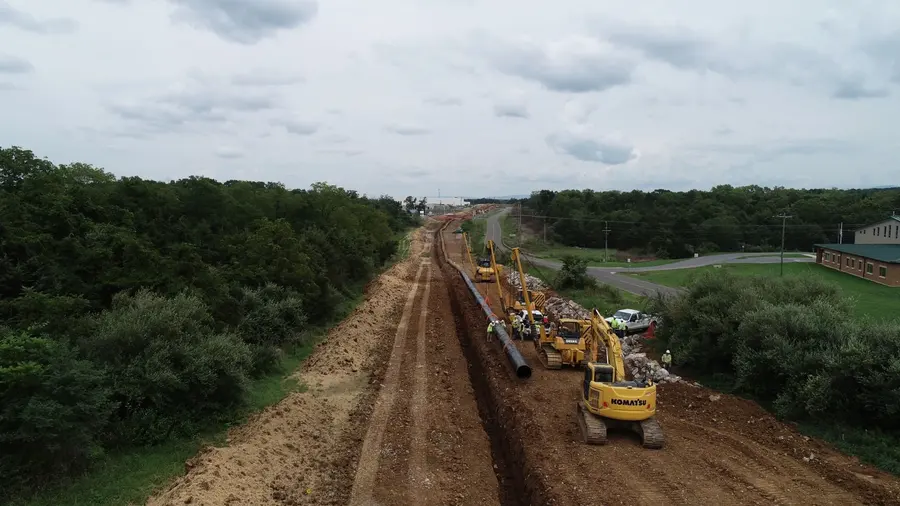
This is the part most people picture: clearing the right-of-way, then stringing, welding, lowering in, testing, and restoring the ground when the pipe is in. Under EPC, the crews building it are tied to the same team that designed it, so what is on paper and what goes in the ground line up. When a field condition turns out different from the survey, and it always does somewhere, the answer does not require a round of letters between separate firms. The people who can make the call are already accountable for the outcome.
There is a self-perform angle here that owners tend to appreciate. A contractor that runs its own crews across the scope, from mainline work to horizontal directional drilling to hydrostatic testing to fabrication, keeps the schedule and the quality in fewer hands. Fewer subcontracts means fewer seams where a date can slip or a detail can fall through. It also means the same safety culture and the same standards apply from the first clearing crew to the final tie-in.
Why owners combine them
The real value of EPC is not some trick of scheduling. It is accountability. In a split delivery, when something slips, the engineering firm points at the permit team, the permit team points at procurement, and procurement points at the builder, and the owner is left refereeing a dispute instead of getting a pipeline. Under one contract, there is a single contractor responsible for all of it, and there is no one else to point at.
That single point of responsibility also gives the owner a simpler relationship to manage. One contract, one schedule, one team to call when a question comes up. For a lean owner who does not want to staff up a full project management office just to build one line, that consolidation is often the whole reason to go this route. It trades a stack of interfaces for a single one.
When EPC is the right fit
EPC is not the answer for every project, and an honest contractor will tell you so. If you already run a large pipeline group with your own engineers, your own permitting staff, and long-standing supplier relationships, you may prefer to keep those functions in house and hire a builder for the field work alone. The bundle earns its keep when you do not have that machinery.
That is exactly the situation many data center and power developers find themselves in. They are experts in their own facilities, not in cross-country pipe, and they need someone to carry the gas or the utility line from a line on a map all the way to a tested, working system. For an owner without a pipeline group of their own, a single accountable team is not a luxury, it is the only practical way to get the project built without becoming a pipeline company in the process.
The decision usually comes down to a few honest questions. Do you have the in-house capacity to manage separate engineering, permitting, procurement, and construction contracts, and to own the gaps between them? Is the schedule tight enough that overlapping the phases would genuinely help? Would you rather manage one relationship or four? If the answers point toward keeping it simple, EPC tends to be the cleaner path, and it puts the coordination burden where it belongs, on the contractor rather than on you.
If that sounds like the situation you are in, get in touch and tell us about your project, even if all you have so far is a rough line on a map. We can talk through where it fits and what it would take to carry it from design to a pipeline in the ground.
Frequently asked questions
What does EPC stand for?
EPC stands for engineering, procurement, and construction. On a pipeline job it usually folds in permitting as well, so one contract covers the design, the approvals, the materials, and the building.
How is EPC different from a traditional bid-build project?
In bid-build, the owner gets the design finished, then puts it out to bid and hires a separate builder. In EPC, one contractor owns the design, permits, procurement, and construction together, so the phases stay connected instead of being handed off.
Does one contract mean one company does everything itself?
Not always, but it means one party is accountable for the whole scope. A self-performing contractor does much of the field work with its own crews, which keeps schedule and quality in fewer hands.
Who is EPC a good fit for?
It fits owners who do not run a pipeline group of their own, such as data center and power developers. They get a single team to carry the project from a line on a map to a tested, working pipeline.
When should permitting start on an EPC job?
As early as possible. Permitting often drives the overall schedule, so pulling it into the contract up front lets the design account for what will actually be approved.