August 21, 2026
How Pipelines Cross Roads and Railroads
A pipeline route rarely misses every road and rail line. Here is how those crossings actually get planned, permitted, and built without shutting down traffic.
Key takeaways
- Almost every cross-country route has to cross a road or a rail line, and each crossing needs its own approval from the agency that owns it.
- A bored crossing goes under the road without touching the surface. An open-cut crossing trenches straight through it, under traffic control.
- Casing pipe is often required under a road or railroad, sleeving the carrier pipe so it can be inspected or replaced without disturbing the surface again.
- Railroad crossings run through a separate approval process from the railroad itself, on top of any state or local permit.
A developer once asked why a nine-mile line was going to take longer to permit than to build. The answer had nothing to do with welding or trenching. It had to do with two state highways and a rail spur that the route had to cross, and each one belonged to somebody else with their own rules. That is the part of pipeline work most people never see: the pipe itself is rarely the hard part of a crossing. The permission is.
If your route touches a road or a railroad, and most cross-country routes touch several, it is worth understanding how those crossings actually get planned and built before you lock in a schedule. It shapes the pipeline construction process more than almost anything else on the route.
Why a crossing is its own small project
Every road and every rail line belongs to somebody. A state highway belongs to the state department of transportation. A county road belongs to the county. A rail line belongs to the railroad that operates it. None of them care that your project has a schedule. Each one has its own approval process, its own engineering standards, and its own idea of what a safe crossing looks like.
That means a route with six crossings on it is really six small projects layered inside the bigger one. Each crossing gets its own design, its own submittal, its own review, and sometimes its own inspector standing on site the day the work happens. Treating them as an afterthought is how a project that looked simple on a map turns into one that is waiting on paperwork for months.
Bored crossings versus open cut
There are two basic ways to get a pipeline under a road or a track, and the choice is rarely up to the contractor alone.
A bored crossing uses horizontal directional drilling or a similar trenchless method to steer a path underground and pull the pipe through behind it. The road or the track never gets opened. Traffic keeps moving, trains keep running, and the surface is untouched when the work is done. This is the default for busier roads, mainline rail, and any crossing where an agency will not tolerate a closure.
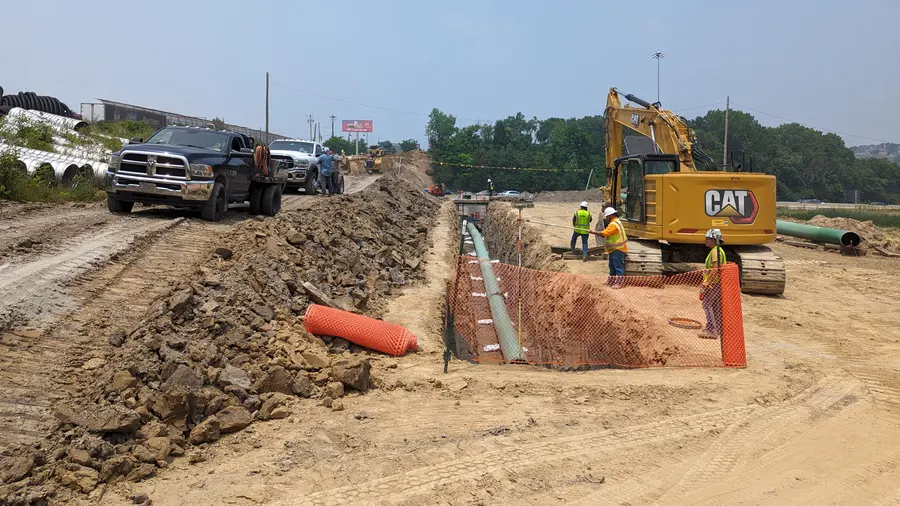
An open-cut crossing trenches straight through the road or the right-of-way, lays the pipe, and restores the surface afterward. It is faster and cheaper where it is allowed, but it means real traffic impact, so it only fits lower-volume roads or crossings where the permit conditions allow a controlled closure. Even then, the work happens inside a traffic control plan that the road authority has approved in advance, often scheduled at night or lane by lane so the road never fully shuts down.
Neither method is automatically the right call. The road classification, the traffic counts, the permit conditions, and sometimes the depth of existing utilities under the crossing all factor into which one a contractor recommends.
What casing pipe is for
At a lot of crossings, especially railroad crossings, the design calls for casing pipe. This is a larger-diameter pipe installed around the actual carrier pipe, like a sleeve. The carrier line runs inside it, insulated from the road or track above and from the excavation that installed it.
The reason casing shows up so often at crossings is maintenance. If the carrier pipe ever needs to be inspected, repaired, or replaced, having it sleeved inside a casing means that work can often happen without tearing up the road or the rail bed a second time. It also gives the road or rail authority a clean boundary for what belongs to the pipeline and what belongs to their infrastructure. Not every crossing requires casing, but where an agency’s standards call for it, it becomes part of the crossing design from day one.
Railroad crossings run on their own track
A road crossing usually means one approval, from the state or the county. A railroad crossing means at least two: the same civil permit a road crossing would need, plus a separate approval directly from the railroad that owns the track.
Railroads are not public agencies. They set their own engineering standards for depth, casing, and construction methods near active track, and they typically require the contractor to carry specific insurance and follow their own inspection process during the work. Some require a railroad-approved flagger on site any time equipment works near the track. Getting that agreement in place, engineered to the railroad’s standard and reviewed by their staff, is its own timeline that runs separately from the state or county permit for the same crossing.
If your route crosses active rail, it is worth asking early in the process, not after the design is finished. A crossing designed to a state standard but not the railroad’s own standard usually has to be redesigned, which costs real time.
What actually happens on crossing day
Even a well-planned crossing takes real coordination on the day the work happens, and it helps to know what that looks like before it arrives on your schedule.
For a bored crossing, the drilling rig and the pulling equipment set up on one side of the road or track, with a receiving pit on the other. The bore itself can take anywhere from hours to a full day or more depending on the length and the ground conditions, and the crew tracks the drill head’s position the entire time to keep it on the designed path. Traffic overhead is usually unaffected the whole time, which is the point of choosing a bore in the first place.
For an open cut, the sequence is tighter and more visible. Traffic control goes up first: cones, signage, flaggers, sometimes a police detail if the road authority requires one. The trench gets opened, the pipe goes in, and the crew works to get it backfilled and the surface restored as fast as the ground and the compaction requirements allow, because every hour the road stays open is an hour the traffic control plan has to hold. Railroad crossings add another layer. A railroad-qualified flagger is often on site any time equipment is within reach of the track, watching for train movements and able to stop work with authority the general contractor does not have on its own.
None of this is unusual for a crew that does crossings regularly. It is unusual for an owner who has never watched one happen, which is exactly why it helps to know what to expect before the crew mobilizes.
How this affects the schedule
Crossings are one of the reasons pipeline timelines rarely track cleanly with mileage. A short line with three difficult crossings can easily take longer to permit than a much longer line with none. Each crossing runs its own review clock, and those clocks do not always run in parallel with the rest of the design.
The practical answer is to identify every road and rail crossing on the route as early as possible, and start each agency’s process the moment enough of the design exists to submit it. Waiting until the rest of the engineering is finished to start on crossing permits is one of the most common ways a schedule slips, because the crossing approvals are often the longest pole in the whole project, not the shortest.
What to ask a contractor about your crossings
If you are comparing contractors for a project with road or rail crossings on the route, ask them to walk through each crossing specifically. A contractor who has done this work will be able to tell you which crossings likely need boring versus open cut, which ones will need casing, and which agencies will be involved before the design is even finished. That level of specificity is a good sign they have actually planned crossings before, not just pipe in open ground.
We self-perform both bored and open-cut crossings with our own crews, and we handle the coordination with the road authorities and railroads directly rather than treating it as someone else’s problem. If your route has a road or a rail line in the way, get in touch and tell us about it. We will walk you through what each crossing is likely to require before you are locked into a schedule that does not account for it.
Frequently asked questions
How does a pipeline get under a busy road without closing it?
Usually with a bored, trenchless crossing, so the road surface is never opened. Where an open cut is unavoidable, the work happens under a traffic control plan approved by the road authority, often at night or in lanes closed one at a time.
What is casing pipe and why is it used at a crossing?
Casing pipe is a larger-diameter pipe installed around the carrier pipe at a crossing. It lets the carrier line be inspected, maintained, or pulled and replaced later without digging up the road or track above it.
Do railroad crossings need a different permit than road crossings?
Yes. A railroad crossing needs approval from the railroad that owns the track, in addition to any state or local permit for the crossing itself. Railroads have their own engineering standards, insurance requirements, and inspection process.
Which crossings usually use open-cut instead of boring?
Lower-volume local roads, farm access roads, and some rail spurs are sometimes crossed with a shored open cut when the traffic impact is manageable and a bore is not needed to meet permit conditions. Busier roads and mainline rail almost always call for a bored crossing.