August 7, 2026
Pipeline Fabrication: Spools, Assemblies, and Tie-Ins
Fabrication builds the fittings, spools, and assemblies that connect a pipeline system. Here is what the scope covers and why it matters to your schedule.
Key takeaways
- A lot of a pipeline system is not straight pipe. Fabrication builds the fittings, spools, and assemblies that turn corners, change size, and connect it all.
- A spool is a section of pipe and fittings built and welded off the ditch line, then set into place as one finished piece.
- A tie-in is the welded connection that joins new pipe into an existing line, a station, or another new section.
- Fabrication and station work travel together, since a lot of the fitting-heavy work lives inside a meter station.
- Appalachian Pipeline self-performs fabrication with its own qualified welders, so quality and schedule stay under one roof.
A construction manager on a power plant project once described the pipeline scope to us in one sentence: dig a ditch, weld some pipe, cover it back up. He was not wrong about the mainline. But when the conversation turned to the meter station, and then to the point where the new gas line had to connect into the plant’s existing yard piping, he stopped and asked a fair question. Who builds the pieces that are not straight pipe, the elbows, the reducers, the manifolds, the odd-angle connections that make the drawing actually work in the field?
That work is fabrication, and it is a bigger piece of a pipeline project than most people outside the industry expect. It is closely related to the specialized services that sit alongside mainline construction, and it shows up on almost every job, mainline or station, in the form of spools, assemblies, and tie-ins. If you are planning a project and have only pictured the ditch, this is the part of the scope worth understanding before you assume it is covered.
What fabrication actually covers
Most of a pipeline is straight run, joint after joint welded end to end down the right-of-way. But a system is never just a straight line. It has to turn corners, step down in diameter, branch off toward a station, and connect to equipment that was not designed with a single piece of pipe in mind. Fabrication is the discipline that builds those pieces: the elbows, tees, reducers, manifolds, and custom assemblies that make the rest of the drawing possible.
Some of it is small, a single fitting welded onto a short run of pipe. Some of it is large and complex, a manifold with a dozen connections that has to match an equipment drawing to the fraction of an inch. Either way, it is fabrication work done to the same welding and inspection standards as the mainline, because a fitting under pressure is just as much a pressure component as a joint of straight pipe.
Spools: pipe built before it reaches the ditch
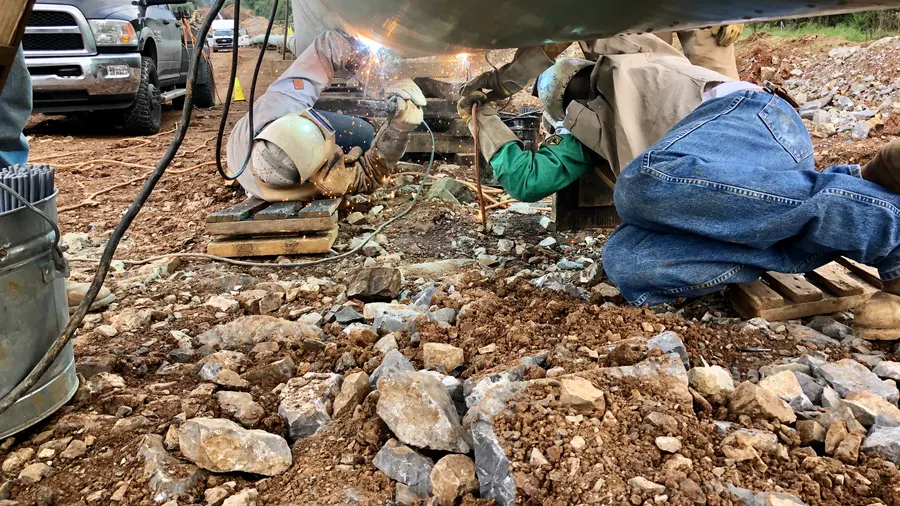
The clearest example of fabrication is a spool. A spool is a section of pipe, fittings, and flanges built and welded together as one complete unit, away from the ditch or the foundation it will eventually sit on. Once it is built, inspected, and coated, it gets hauled to the site and set into place as a single piece.
Building it this way has a real advantage. A fabricator working at a bench or on a set of stands can control fit-up, positioning, and weld access far better than a crew trying to make the same joint in a trench or against a foundation. The work moves faster, the quality is easier to hold, and the field crew’s job becomes lifting and setting a finished piece instead of building it from scratch under worse conditions. That is part of why so much of the complex piping on a job, especially inside a station, gets built as spools rather than assembled joint by joint on site.
Spools also travel well. Once a spool is welded, inspected, and coated, it can sit staged in a laydown yard until the foundation or the tie-in point it belongs to is ready. That flexibility matters on a job where civil work, equipment deliveries, and pipe crews are not always moving at the same pace. Building the piece ahead of time and setting it later, rather than trying to build it in place the moment the foundation cures, is one of the small decisions that keeps a facility schedule from bunching up at the end.
Tie-ins: where a system gets connected
A tie-in is the welded connection that joins one section of pipe to another. It might be new pipe connecting into an existing system, a station connecting into the line that feeds it, or two spreads meeting in the middle of a route after each built its own section. Whatever the situation, a tie-in is usually one of the last welds made before that stretch of pipe goes into service, and it carries a different kind of pressure than a routine mainline joint, because it is often the point where an active system and a new one meet.
That matters for planning as much as for welding. A tie-in into an existing, live system sometimes requires a planned outage or a specific window when the operator can take that segment offline. Get the timing wrong and you are not just behind schedule, you have missed a window that might not come around again soon. A contractor building the fabrication and running the tie-in crew has to plan that sequence with the same care as the rest of the job, not treat it as a formality at the end.
Why welding standards do not relax in the shop
It is worth being direct about one thing: fabrication is not a lesser cousin of mainline welding. Every fitting, spool, and assembly is a pressure component, and it gets built to the same codes and the same inspection requirements as the pipe in the ditch. A weld on a six-inch elbow inside a station gets x-rayed or otherwise inspected the same way a weld on the mainline does.
The reason is simple. Pressure does not know the difference between a straight run and a fabricated fitting. A flaw in either one is a flaw in the system, and the consequences do not scale down just because the piece is smaller. Fabricators working this scope are qualified welders held to the same standard as the crews welding out on the pipeline right-of-way, and the paperwork proving that inspection happened travels with the job the same way it does for the mainline.
Fabrication and station work travel together
A lot of fabrication work lives inside a facility rather than out on the mainline. Meter stations are dense with fittings, valves, and manifolds, because that is where a system measures and regulates what is moving through it, and that kind of equipment does not connect with straight pipe alone. We covered what goes into building one of these facilities in an earlier post on meter station and civil construction, and fabrication is the mechanical half of that scope, the piping and assemblies that route product through the meters and regulators and back out to the line.
Because of that overlap, fabrication capability and station capability tend to sit with the same crews. A contractor who fabricates well is usually the same contractor who builds stations well, since the two skills are really one skill applied in different places on the site.
Why self-performing fabrication matters
When a pipeline contractor subs out fabrication to a separate shop, that shop is not the one answering for the schedule of the mainline or the station around it. Spools have to be ordered, built, inspected, and delivered on a timeline set by someone else, and if that shop falls behind or a piece does not fit right on arrival, the field crew is the one standing around waiting for a fix that is not theirs to make.
We self-perform fabrication with our own qualified welders, the same people connected to the rest of the crew running the job. That keeps the sequencing in one set of hands. If a spool needs to change because a field condition is different from the drawing, the fabricator and the field superintendent are on the same team having the same conversation, not two companies working through a change order. It is the same logic behind self-performing across the rest of the scope: fewer hand-offs, fewer places for a delay to hide, and one party accountable for the result.
What to ask if fabrication is part of your project
If your project includes a station, a complex tie-in, or any piping beyond a straight run, it is worth asking directly who builds the fittings and spools, and whether that work is done in-house. A contractor with its own fabrication capability can usually tell you where the work happens, how it is sequenced against the field schedule, and how a change in the field gets fed back into the shop. A contractor who subs this scope out will usually describe it as someone else’s problem to manage.
It is a good addition to the questions worth asking before you sign a contract, right alongside safety standing and self-perform capability on the mainline itself. The answer tells you whether the pieces that are not straight pipe are going to show up on time and fit the way the drawing says they will.
If you have a project with fabrication, station piping, or tie-in work as part of the scope, get in touch and request a bid. Tell us what the job needs, and we will walk you through how we would build and sequence it.
Frequently asked questions
What is fabrication in pipeline construction?
Fabrication is the work of building the fittings, spools, and assemblies that a pipeline system needs beyond straight pipe. It includes cutting, fitting, and welding pieces together in a shop or a laydown yard before they are set and tied into the line or a station.
What is a spool in pipeline work?
A spool is a section of pipe, fittings, and flanges built and welded together as one unit, away from the ditch or the station foundation, then lifted into place as a single piece. Building it ahead of time lets fabricators work at a bench instead of in a trench.
What is a tie-in on a pipeline?
A tie-in is the welded connection that joins one section of pipe to another, whether that is new pipe meeting an existing system, a station connecting to the line that feeds it, or two spreads meeting in the middle of a route. It is usually one of the last welds made before a section goes into service.
Does Appalachian Pipeline self-perform fabrication?
Yes. Fabrication is one of our self-performed specialized services, done with our own qualified, inspected welders rather than subbed out to a separate shop.
Where does fabrication happen on a project?
It can happen in a fixed shop, in a mobile fabrication trailer set up near the job, or in a laydown yard close to the right-of-way. The location depends on the size of the pieces and how far they have to travel to reach the ditch or the station foundation.