
October 20, 2026
Civil and Concrete Construction on a Pipeline Facility Site
Pads, foundations, and below-grade vaults are their own trade on a pipeline facility. What the civil and concrete scope covers, and why it drives the schedule.
Key takeaways
- Civil and concrete work is its own trade on a facility site. It is not site prep, it is the foundation everything else gets built on.
- Pads, foundations, and vaults have to be poured to real tolerances, because the equipment set on top of them has to line up exactly.
- Concrete has to cure before equipment can be set on it, which is a fixed amount of time no schedule can shortcut.
- Drainage, access, and fencing get overlooked, but a station that floods or cannot be reached is a station that cannot be maintained.
- Appalachian Pipeline self-performs civil scope so the concrete crew and the pipeline crew answer to the same schedule.
An estimator pricing a new valve site once described the civil scope in one line on the budget: pad and fence. The piping, the valve, and the fabrication got their own detailed takeoff, because that is the part of the job that shows up on the process drawing. The concrete did not get the same attention, right up until the crew arrived to set the valve and found a pad poured a half inch out of level.
That gap between how much attention civil work gets and how much it actually matters is common, and it is worth closing before you are the one standing on a half-inch-out pad. We touched on parts of this scope in an earlier post on meter station and civil construction and again when we covered what gets built at a block valve or launcher site. This post goes one layer deeper, into the civil and concrete discipline itself: what it covers across any facility, not just one kind, and why it tends to be the part of a job that quietly sets the schedule for everything built on top of it.
If your project includes any facility beyond a straight run of mainline pipe, this is worth understanding before you assume it is covered along with everything else.
Civil work is not site prep, it is construction
It is easy to lump civil work in with clearing and call it preparation for the real job. That framing undersells it badly. Civil and concrete construction on a facility site is its own trade, with its own crews, its own sequencing, and its own way of going wrong, and it is the thing every other piece of the facility gets built on top of, literally.
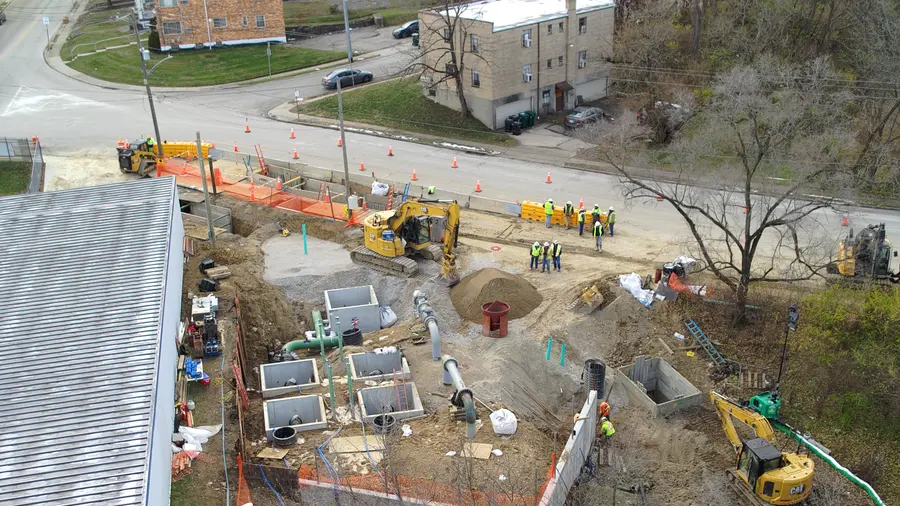
The scope covers grading the site so it drains correctly, pouring the pad and foundations the equipment will sit on, building any below-grade structures the design calls for, putting in the access road, and installing fencing and drainage around the whole site. None of it is glamorous. All of it has to be right before the piping crew, the equipment supplier, or anyone else can start their part of the job.
Pads and foundations carry real tolerances
A pad is not just a flat surface. It is poured to hold specific equipment, set at a specific elevation, with anchor points and penetrations located to match an equipment drawing down to a fraction of an inch. Get a foundation wrong by even a small margin and the valve, the meter skid, or the regulator that was supposed to set on it does not line up, and now you are grinding, shimming, or in the worst case, breaking out concrete and pouring again.
That is the real cost of treating concrete as an afterthought. Fixing a foundation after the fact is slow, it is on the critical path by definition, and it almost always costs more than getting it right the first time would have. A crew that pours facility concrete regularly reads the equipment drawing the same way a fabricator reads a piping isometric, because the tolerance is the whole point of the pour.
Vaults and below-grade structures
Not everything on a facility site sits above grade. Some valves, instrumentation, and other equipment get housed in a vault, a below-grade concrete structure built to protect what is inside it and still give crews controlled access when they need to reach it. A vault gets built to the same standard as any other concrete structure on the site: formed, reinforced, and poured to hold its shape and its load for the life of the facility, with a lid or access point sized and located to match what has to go in and out of it.
Vaults add their own wrinkle to planning, because they usually mean excavation, backfill, and compaction in addition to the pour itself, and they have to be coordinated with whatever is going inside them before the concrete sets, not after. A vault built to the wrong dimensions is a much harder fix than a pad poured slightly off, because digging a hole back open is its own piece of work on top of the concrete repair.
Drainage, access, and fencing get overlooked
The parts of civil scope that get the least attention are often the parts that cause the most trouble later. Drainage is the clearest example. A facility site that does not shed water correctly turns into standing water around equipment, which is a maintenance and corrosion problem that follows the station for as long as it operates. Getting the grading and drainage right at the start is far cheaper than fighting a wet site for years afterward.
Access and fencing matter in a quieter way. A facility needs a road that can carry trucks and maintenance crews for the life of the site, not just during construction, and it needs fencing and security appropriate to a controlled facility. Skimp on either and you have built a station that is hard to reach or hard to secure, which is exactly the kind of problem nobody notices until the day it matters.
Why concrete sets the pace, whether you plan for it or not
Concrete does not care about your schedule. Once it is poured, it needs a fixed amount of time to cure before it can carry the load of the equipment going on top of it, and that curing time is set by the mix design and the weather, not by how much the project needs to move faster. Push equipment onto a pad before it has cured enough and you risk cracking or settling that shows up later, often after the equipment is already set and much harder to fix.
That is why civil work belongs at the front of a facility schedule, not tucked in alongside it. The pour has to happen early enough that curing time does not collide with the date equipment is supposed to arrive and be set. A contractor who has built facility civil work before plans backward from that equipment date and works out when the pour has to happen to make it, rather than discovering the conflict once the concrete truck is already on site.
Why we keep civil work in-house
When civil and concrete work is subbed out separately from the rest of a facility job, it becomes another seam for the schedule to open up in. The concrete crew works off its own schedule, the piping and equipment crews work off theirs, and if the pad is not ready when the equipment shows up, or the equipment drawing changes after the pour, two companies have to work out what happens next while the clock keeps running.
Appalachian Pipeline self-performs the civil and concrete scope on our facility work, the same crews and the same chain of command running the rest of the specialized services on the job. That means the person pouring the pad is coordinating directly with the person who has to set equipment on it, not waiting on a phone call between two separate companies. It is the same logic behind self-performing across the rest of the scope: fewer hand-offs, and one party accountable for the result.
What to ask about the civil scope
If your project includes a meter station, a valve site, a launcher or receiver, or any other facility, it is worth asking directly who pours the concrete and whether that crew is in-house. Ask how the civil schedule lines up with equipment lead times, and ask what happens if a foundation needs to change after it has already cured.
Those are good additions to any list of questions worth asking a contractor before you sign. A contractor who has done this work will walk you through the sequence in specifics: when the pour has to happen, how long it needs to cure, and how that date was set against your equipment delivery. A contractor who has not will talk about the pad like it is a line item instead of a piece of construction with its own schedule risk.
If you have a facility project and want a straight read on how the civil scope fits your timeline, get in touch and request a bid. Tell us what is going into the site, and we will walk you through how we would plan and pour it.
Frequently asked questions
What counts as civil work on a pipeline facility?
Civil work is everything the facility sits on and inside of: clearing and grading the site, pouring the concrete pad and equipment foundations, building any below-grade vaults, putting in drainage, the access road, and the fencing around it. It is separate from the piping and equipment scope, but it has to happen first.
What is a vault on a pipeline facility?
A vault is a below-grade concrete structure that houses a valve, instrumentation, or other equipment, built to protect it and give crews controlled access without leaving it exposed at the surface. It gets built to the same tolerances as any other concrete structure on the site.
Why does concrete curing time matter to a project schedule?
Equipment cannot be set on a pad or foundation until the concrete has cured enough to carry its weight. That curing time is fixed by the concrete mix and the weather, not by how badly the schedule needs the equipment set sooner, so it has to be planned for rather than compressed later.
Why does Appalachian Pipeline self-perform civil and concrete work?
Because the civil scope and the pipeline scope have to line up at the tie-in. When the same contractor runs both, the concrete crew and the pipe crew work off the same schedule and the same superintendent, instead of two companies negotiating around each other's delays.
Is civil work the same on every facility?
No. A meter station, a valve site, and a launcher or receiver each need a different footprint and a different mix of pad, vault, and access work, sized to the equipment going in. The principles are the same, but the plan has to match the specific facility.