September 15, 2026
Pipeline Welding and Weld Inspection: How Every Joint Gets Proven
How pipeline welds get made and inspected, from qualified welders through non-destructive testing, before a joint is trusted to hold for decades.
Key takeaways
- Every weld on a pipeline is a pressure joint that has to hold for decades, which is why it gets checked as carefully as it is made.
- Welders work from a qualified procedure and are themselves operator qualified before they touch a covered task on the line.
- Most joints get checked with non-destructive testing, methods that find flaws inside the metal without cutting the weld open.
- A weld that does not pass inspection gets cut out and rewelded, not patched, because a pipeline does not get a second chance at integrity.
- Weld inspection is what makes hydrostatic testing meaningful. The line only gets pressure tested after every joint has already been proven on its own.
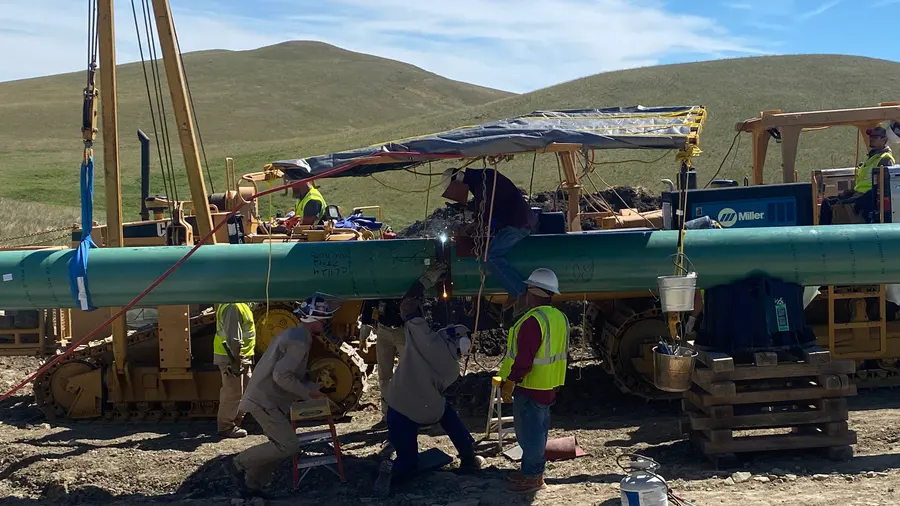
A gas utility engineer stopped by a right-of-way last fall to check on a distribution tie-in her company had contracted out. She expected to find pipe going into the ground. Instead she found a welder finishing a joint while two other people stood over it with equipment that looked more like something from a clinic than a construction site, checking that weld before anyone moved to the next one. She had signed off on the budget for this project. She had never actually watched how a pipeline gets built, joint by joint.
That gap is common. Most people who buy pipeline construction understand that sections of pipe get welded together, and their understanding stops about there. Few realize that the weld itself, not the trench, not the coating, is the one step the rest of the line’s integrity rests on. Every joint has to be made correctly and then proven correct, and the process behind both is more exacting than almost anything else that happens on a right-of-way. It is worth understanding, especially if you are still learning how a pipeline project comes together stage by stage.
This post walks through what happens between the moment a welder strikes an arc and the moment that joint is cleared to carry product for decades.
Why the weld carries more weight than anything else on the line
A pipeline is not one long piece of steel. It arrives on site as sections, and those sections become a continuous line only through the welds that join them. Every one of those joints is a pressure boundary, meaning it has to hold whatever the line is designed to carry, at whatever pressure the system runs, for the life of the pipeline. There is no part of the route where a weak joint is acceptable, because pressure does not care whether a flaw sits under a highway or out in open pasture.
That is why welding does not get treated as a production task to move quickly through. It gets treated as the step everything downstream depends on. The coating protects the pipe from the outside. The backfill protects it from the ground above. The weld is what keeps the inside of the line where it belongs, and nothing later in the sequence can fix a joint that was not made right in the first place.
Working from a qualified procedure, not a welder’s habit
A pipeline welder is not free to weld however they were taught to weld somewhere else. Each project works from a qualified welding procedure, a document that specifies the exact parameters for that pipe: the material, the joint design, the filler metal, the number of passes, and the technique for each one. The procedure itself has been tested and proven to produce a sound weld before it is ever used in the field.
Welders then have to be qualified to that specific procedure before they are allowed to work on it. That qualification is tied to the same rules behind operator qualification, which confirms that the person doing a covered task on a pipeline is actually trained and current to do it, not simply experienced in general. On a union job, the welder has already come through a hall with its own testing and training standard before that project-specific qualification ever happens, which is one of the reasons being signatory to the trades matters as much as it does on this kind of work. The result is a welder who is checked against a standard more than once before an arc is ever struck.
Visual inspection happens while the work is still moving
The first layer of inspection is visual, and it happens in real time as the weld is being made, not afterward as a separate step. An inspector looks at each pass for the obvious defects: cracks, incomplete fusion where the weld did not properly bond to the base metal, porosity from trapped gas, and a bead profile that does not match what the procedure calls for. Catching a problem at this stage is the cheapest place to catch it, because the weld has not gone any further and nothing has been built on top of it yet.
Visual inspection is not a formality squeezed in between other tasks. It is built into the pace of the work itself, which is one reason a well-run crew keeps welding and inspection moving at the same rhythm rather than letting one get ahead of the other. A spread that lets its welders race too far ahead of inspection is a spread that is trading speed for risk it will have to pay back later.
Non-destructive testing looks inside the metal
Visual inspection catches what is visible on the surface. It cannot see a flaw sitting inside the weld itself, which is where non-destructive testing comes in. NDT covers a handful of methods, each suited to different conditions and different parts of a project:
- Radiographic testing uses radiation to create an image of the inside of the weld, similar in principle to an X-ray, revealing voids or inclusions that are invisible from outside.
- Ultrasonic testing sends sound waves through the metal and reads how they bounce back, which can locate flaws and measure their size without radiation.
- Magnetic particle testing uses a magnetic field and fine particles to reveal surface and near-surface cracks that are too subtle to see with the eye alone.
What all of these methods share is the word non-destructive. They let an inspector see inside a joint and confirm it is sound without cutting it open, so a weld that passes stays exactly as it was built. That matters on a project where thousands of welds have to be checked without disassembling the line to do it.
A weld that does not pass does not get a second chance in place
Here is the part that surprises people who have not spent time around this work. A weld that fails inspection is not patched, ground smooth, or left in place with a note to watch it. It is cut out of the line entirely and rewelded from scratch, then inspected again before anyone moves forward. There is no partial credit for a joint that does not meet the standard.
That rule exists because a pipeline weld is not a place where a compromise is available. Grinding over a flaw or welding a patch on top of one does not remove the defect. It only hides it, and a hidden defect in a pressure joint is a liability that gets worse with time, not better. Cutting out and rewelding costs time and material in the moment, which is a real cost on a project already tracking a schedule, but it is a far smaller cost than discovering the same flaw after the line is buried and pressurized. This is also part of why pricing structure matters so much on pipeline work. Rework on a weld is not corner-cutting. It is the standard working exactly as it should.
Weld inspection is what makes hydrostatic testing meaningful
Once welding and inspection are complete along a section of line, the pipe still has one more proof step ahead of it. Hydrostatic testing fills the completed, buried line with water and raises the pressure well above what it will ever see in normal operation, holding it there to confirm the whole system holds without a leak.
That test only means something because of the work that came before it. Hydrostatic testing checks the line as a complete assembly, but it is not designed to catch every individual weld flaw the way joint-by-joint inspection does. The two steps do different jobs, one confirming each connection on its own and the other confirming the whole line together, and a project needs both to be genuinely proven before it goes into service.
Why self-performing welding and inspection matters
When the crew making the weld and the inspectors checking it work for the same contractor, the incentive structure stays clean. There is no seam where a subcontracted welding crew and a separately hired inspection firm have to reconcile different standards or different urgency about the schedule. The same organization is accountable for both the weld and the proof that it is sound, which is part of why fabrication and welding capability sits inside our self-performed scope rather than being handed to outside crews.
That accountability shows up in how a job actually runs. When a weld gets flagged, the decision to cut it out and rework it is not a negotiation between two companies with different interests. It is the same team fixing its own work to the same standard it started with, which is a simpler and more honest way to build a line that has to last.
If you are planning a project and want to understand how welding, inspection, and testing fit together on your specific route, get in touch and tell us what you have, even if all you have so far is a line on a map. We will walk you through what the sequence actually looks like before you commit to a schedule.
Frequently asked questions
What is weld inspection in pipeline construction?
It is the process of checking every welded joint on a pipeline for defects before the line is backfilled and put into service. It starts with a visual check of the weld as it is made, then moves to non-destructive testing methods that look inside the metal for flaws that are not visible from the surface.
What is non-destructive testing (NDT) on a pipeline weld?
NDT covers methods like radiographic testing, which uses radiation to image the inside of a weld, and ultrasonic testing, which uses sound waves to find flaws. Both let inspectors see inside the joint without cutting it open, so the weld stays intact if it passes.
Who is qualified to weld on a pipeline?
Welders have to be qualified to a specific procedure before they are allowed to work on covered pipeline tasks, which ties back to operator qualification rules. On a union job, that welder also comes through a hall with its own training and testing, so the qualification is checked more than once before anyone strikes an arc.
What happens if a weld fails inspection?
It gets cut out of the line and rewelded, then inspected again before the crew moves on. A flagged weld is never patched or left in place, because a pipeline joint either meets the standard or it does not stay in the ground.
How does weld inspection relate to hydrostatic testing?
Weld inspection happens joint by joint as the line is built, checking each one on its own before it ever goes into the ground. Hydrostatic testing comes later and proves the whole assembled line at once, under pressure. The line is not ready for that test until every weld along the route has already passed inspection.