September 18, 2026
Trenching Through Rock on Pipeline Projects
Rock along a pipeline route changes the equipment, the pace, and the plan. What rock trenching actually involves and why it belongs in your schedule early.
Key takeaways
- Rock does not just slow a trench down. It changes the equipment, the sequence, and the crew needed to open it.
- A route is not confirmed rock-free just because a survey did not flag it. Geotechnical data early is what keeps rock from becoming a surprise mid-spread.
- Rock trenching uses different tools than dirt: rock saws, hydraulic hammers, and sometimes controlled blasting, chosen to fit the ground and the permit.
- Rock changes production rates, so a spread has to be paced differently, not just pushed harder, when it hits a rock section.
- Protective systems in a rock trench still matter. Rock is not automatically stable ground, and it still gets treated that way.
An EPC project manager pulled the geotechnical report for a new gas line and found a single line buried in the appendix: shallow rock across roughly two miles of the route. It did not look like much on paper. Then the schedule came back from the contractor with three extra weeks built into that same two-mile stretch, and the manager wanted to know why a few miles of ground could move the date that much.
The honest answer is that not all ground is the same, and pipeline construction treats rock as its own category of work, not a harder version of dirt. A spread that is humming along at a steady pace through soil hits a different rhythm entirely when the trench line runs into rock, and understanding why is worth doing before a schedule gets built around the wrong assumption.
This is one of the parts of a pipeline project that rarely gets discussed until it shows up on a bid, so here is what rock trenching actually involves, how crews handle it, and what it means for a project’s timeline.
Why rock is not just harder dirt
Soil comes out of a trench in a fairly predictable way. A standard excavator bucket digs at a steady rate, the walls behave according to soil type, and a crew can plan a day’s progress with reasonable confidence. Rock breaks that pattern entirely.
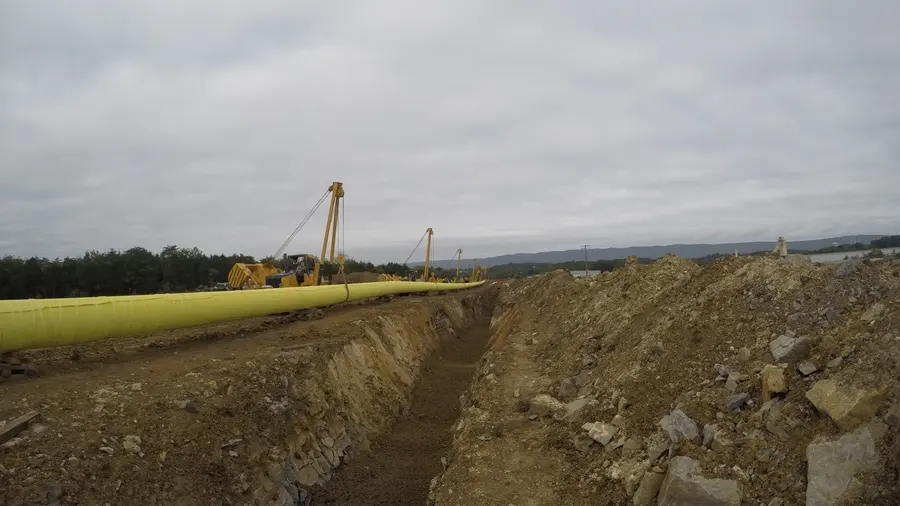
Rock has to be separated from the ground before it can be removed, and that separation step is the whole difference. Depending on how hard and how fractured the rock is, that might mean ripping it apart with a heavy bucket, breaking it up mechanically, or cutting and fracturing it before an excavator can even start pulling material out of the trench. None of those steps exist when you are digging soil. Every one of them adds time, and none of them scale down neatly just because the trench itself is not very long.
That is the piece that catches people off guard. A two-mile rock section is not two miles of the same pace as the rest of the route, slightly slower. It can run at a fraction of the daily footage a soil section covers, which is exactly the gap that turned into three weeks on that project manager’s schedule.
How crews find out what they are dealing with
The first read on rock comes from geotechnical work done well before construction starts: borings and test pits spaced along the proposed route, logged and analyzed to flag where rock sits close to the surface and how hard it is likely to be. That data is what lets a contractor build a realistic schedule and bid instead of guessing.
Good geotechnical data is not the same as complete certainty, though. Rock does not always follow a neat, continuous layer. It can be fractured, weathered, or simply absent in a way that a handful of borings spaced along a long route cannot fully capture. That is why experienced crews keep probing ahead of the active trench as the work moves, rather than trusting the design data alone once construction is underway. Finding out early, even a few hundred feet ahead of the bucket, is what keeps a rock section from becoming a full stop.
The methods that get used
There is no single way to trench through rock, because rock itself is not one thing. The method has to fit the specific ground and, in some cases, what the permit allows.
Softer or more broken-up rock can sometimes be handled with a heavy excavator bucket built for ripping, which is the least disruptive option when it works. Harder or more solid rock often needs a hydraulic hammer, commonly called a hoe-ram, mounted on an excavator to break the material into pieces small enough to remove. For the hardest or most continuous rock, a rock saw can cut a controlled trench line before the material is excavated, which keeps the trench width and depth closer to design. In select situations where the rock will not yield to any of those methods, and where it is permitted, controlled blasting fractures the rock ahead of excavation.
Choosing the right method is not a formality. The wrong choice slows a crew down further or risks a trench that does not match the design, so the decision gets made with the geotechnical data, the depth requirements, and the surrounding conditions all in view.
What it does to the pace of the job
A spread is built around keeping every crew moving in balance: clearing ahead of stringing, stringing ahead of welding, welding ahead of lower-in. Rock breaks that balance if it is not planned for, because the trenching crew suddenly cannot keep pace with everyone lined up behind it.
The fix is not pushing harder. It is planning differently. A contractor who has done this work will resequence around a known rock section, sometimes running trenching crews ahead of schedule specifically to build a buffer before the rock starts, sometimes bringing in the right equipment before the crew ever reaches that stretch of ground instead of mobilizing it after progress has already stalled. That kind of planning is exactly what separates pipeline timelines that hold from ones that slip once the ground stops cooperating.
Rock trenches still need real protective systems
It is a common assumption that rock is inherently stable and that the safety rules built around soil trenches do not fully apply. That is not accurate. A rock face can look solid and still have fracture planes, loose sections, or weathered zones that behave in ways a smooth soil wall does not.
The same standard applies here that applies to any open trench: a competent person assesses the actual ground in front of them, not just the label on a geotechnical map, and chooses a protective approach that fits what is really there. Crews working in trench safety and shoring day to day know that rock changes the method, not the requirement to protect the people working inside the trench.
When rock means a different method entirely
Sometimes the honest answer is that open-trench rock excavation is not the right call at all. In terrain where rock is deep, continuous, or sits under a sensitive area, horizontal directional drilling can steer a path underground and avoid opening a rock trench on the surface altogether.
That decision gets made project by project, weighing the depth and extent of the rock, the surface conditions, the permit requirements, and the schedule against each method. A contractor who has actually built through rock before can walk you through that comparison with real numbers instead of a guess, which is one of the better questions to ask before you hire anyone for a route that geotechnical data flags as rocky.
A few things worth asking a contractor directly if your route has rock on it:
- How they read the geotechnical data and where they expect production rates to change
- What equipment they would bring for the specific rock conditions on your route
- How they would resequence the spread around a known rock section
- If any part of the route might make more sense as a bored crossing instead of open trench
Answers with real detail tell you the contractor has actually planned for it. A vague answer usually means they have not looked closely yet.
Plan for the rock before it plans your schedule
Rock is not rare on a pipeline route, and it is not something worth avoiding at all costs, either. What matters is knowing where it is early, understanding that it changes the equipment and the pace, and building the plan around that reality instead of discovering it mid-spread. A contractor who treats rock as its own piece of the job, not an afterthought bolted onto the same schedule as everything else, is the one who keeps your project on the date you were promised.
We self-perform trenching across the full range of ground conditions our specialized services scope covers, rock included, with the equipment and crews to match the method to the ground. If your route has rock on it, or you are not sure yet, get in touch and tell us what you know. We will walk you through what it is likely to mean for the schedule before you are locked into a date that did not account for it.
Frequently asked questions
Why does rock slow down a pipeline trench so much?
Soil can be dug with a standard trenching bucket at a steady, predictable pace. Rock cannot. It has to be ripped, hammered, sawed, or in some cases blasted before it comes out of the ground, and each of those methods runs slower than digging dirt. The deeper or harder the rock, the bigger the gap between rock production rates and soil production rates.
How do crews know where the rock is before they start digging?
Geotechnical borings and test pits along the route give the first read, usually done well before construction starts. Even with good data, crews often probe ahead of the active trench as they go, because rock can vary within a short stretch of route in ways a handful of borings do not fully capture.
What equipment is used to trench through rock?
It depends on the rock. Softer or more fractured rock can sometimes be ripped with a heavy excavator bucket or broken up with a hydraulic hammer, often called a hoe-ram. Harder rock may call for a rock saw that cuts a controlled trench line, and in some cases, where permits allow it, controlled blasting to fracture the rock before excavation.
Is trenching through rock less safe than trenching through soil?
It is different, not automatically worse, but it is not automatically safer either. Rock trench walls can look solid and still have fracture planes or loose sections that behave unpredictably. A competent person still has to assess the ground and the protective system still has to fit what is actually there, not just what the material is called on a map.
Should a route just avoid rock entirely?
Not usually, since most routes cross some rock somewhere and rerouting around all of it is rarely practical. The better move is identifying where the rock is early, so the contractor can plan the method, the equipment, and the schedule around it instead of finding out when the bucket stops digging.