
November 17, 2026
What Does a Regulator Station Do on a Pipeline?
What a regulator station does on a pipeline, how it differs from a meter station, and why the civil work and equipment lead times matter early.
Key takeaways
- A regulator station steps pipeline pressure down from what one system carries to what the next section, or the end user, is built to handle.
- Regulation and metering are different jobs. One controls pressure, the other measures volume, and a site can house either one or both.
- Overpressure protection, relief valves and slam-shut devices, is what keeps a regulator station safe if pressure control itself fails.
- Like any facility, a regulator station needs its own civil and foundation work before the piping and equipment can be set.
- Regulator stations carry real equipment lead times, so they belong on the schedule early, the same as any other facility on the job.
A developer’s engineer is reviewing a tie-in drawing for a new gas line and notices two boxes near the end of the route. One is labeled meter station. The other is labeled regulator station. The assumption going in was that one facility would cover both jobs. Now there are two boxes on the drawing, and the obvious question is why, and what is actually different between them.
It is a fair question, and one that comes up often once a specialized services scope gets past the pipe in the ground and into the facilities a system actually runs on. We covered what a meter station does in an earlier post on meter stations and civil construction, and that post touched on regulation as part of the metering function. This one goes the other direction. It is about the regulator station itself: what it does on its own, what gets built at one, and why it belongs on the schedule and the land plan as early as any other facility on the route.
What a regulator station actually does
A pipeline does not carry the same pressure everywhere. A transmission line moves gas at a high pressure because that is the efficient way to move a lot of product a long distance. The system it feeds into, whether that is a distribution line, a plant, or a piece of equipment at the end of the route, is built to handle something lower. A regulator station is the facility that makes that transition. It reduces, or regulates, the pressure coming in to whatever the downstream side is designed to take.
Think of it as a step down, not a shutoff. The gas keeps moving. What changes is the pressure it is moving at, controlled to a set point so everything built downstream, pipe, valves, and equipment alike, is operating inside the range it was engineered for. Get that step-down wrong, high or low, and you either stress equipment that was never rated for the pressure it is seeing or starve a system of the pressure it needs to function.
Regulation and metering are different jobs
It is easy to lump a regulator station in with a meter station, because they often sit close together and sometimes share a fence line. The jobs themselves are not the same. A meter station measures the volume of gas passing through, which is the number everybody downstream relies on for billing, allocation, and custody transfer. A regulator station controls pressure, not volume.
A single facility can do both, and plenty do, especially where a line is making the pressure transition at the same point it needs to be measured anyway. But they are still two distinct functions, built around different equipment and different failure modes, and a developer planning a tie-in should understand which one, or which combination, their project actually needs rather than assuming one facility automatically covers the other.
What gets built inside a regulator station
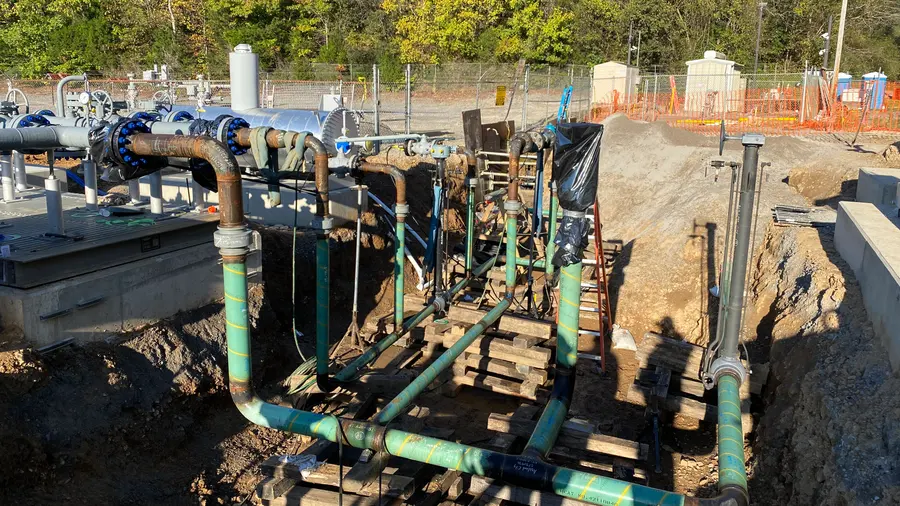
A regulator station is not a single valve sitting in a pipe. It is piping and equipment built to take an incoming pressure and deliver a controlled outgoing pressure, reliably, for the life of the facility. That means regulators themselves, sized and set for the pressure drop the job calls for, along with the piping, valves, and fittings that route the gas through them and back out to the line. Most stations run more than one regulator in sequence or in parallel, so the system has backup capacity if one unit needs to come offline for maintenance without shutting down the whole facility.
Filtration usually shows up in the same piping run, because clean gas protects the regulators themselves from debris that would otherwise wear or foul the control elements. None of this is exotic equipment, but it has to be specified, fabricated, and tied in correctly, which is the same fabrication discipline that goes into any other piece of station piping on the job.
The sizing of the regulators is its own piece of engineering, separate from the civil and fabrication work. A regulator sized for the wrong flow rate either cannot deliver the volume the downstream side needs during peak demand or operates so far off its ideal range that it wears out faster and controls pressure less precisely than it should. That sizing has to be worked out against real flow and pressure data for the specific tie-in, not assumed from a nearby project, because no two points on a system see exactly the same demand.
Why overpressure protection is not optional
A regulator is a mechanical device, and mechanical devices can fail. That is exactly why a regulator station is not designed around a single point of control. Relief valves are built into the system to vent excess pressure if it climbs past a safe limit, and slam-shut devices will close the line entirely if the regulation itself does not hold. Those are fail-safe systems, meant to activate automatically, without anyone standing there to catch the problem in real time.
This layered protection is what lets a regulator station run unattended for long stretches, which most of them do. A developer evaluating a facility design should expect to see this protection called out explicitly, not assumed. If a design does not account for what happens when a regulator fails, that is a gap worth raising before construction, not after.
The civil work a regulator station still needs
Like any pipeline facility, a regulator station sits on a pad and a foundation before anything else gets set. The site has to be graded so it drains correctly, the foundation has to be poured to the tolerances the equipment drawing calls for, and the facility needs drainage, access, and fencing like any other controlled site. We went into this scope in more depth in a post on facility civil and concrete construction, and the same logic applies here. The concrete has to cure before the regulators and piping can be set on it, and that curing time does not bend for a tight schedule.
Regulator stations are not unique in this respect. A block valve or launcher site needs the same kind of civil groundwork, sized to its own equipment instead of a regulator skid. The principle carries across every facility on a route: the civil scope comes first, and it sets the pace for everything built on top of it.
Why equipment lead times put it on the schedule early
Regulators, relief valves, and slam-shut devices are ordered equipment, not parts pulled off a shelf. They carry real lead times, and those lead times run on their own clock regardless of how the rest of the project is tracking. If the facility design is not settled early, the order for that equipment goes in late, and the civil work can sit finished and cured while everyone waits on hardware that should already be on site.
That is the honest reason a regulator station belongs in the plan at the same point the route itself gets finalized, not after the mainline scope is already underway. A developer who treats the facility as an afterthought to the pipe in the ground is the one most likely to find it sitting on the critical path later, for reasons that had nothing to do with construction and everything to do with an order that went in too late.
This is especially true on projects where the pipeline is already racing long-lead equipment elsewhere on site, such as a plant’s turbines or a data center’s switchgear. A regulator station that gets designed late does not just risk its own schedule. It risks becoming the one piece of the gas side that is still waiting on hardware after everything else is ready to go into service.
Keeping the regulator station on the same schedule as the line
A regulator station that ties into a new line works best when it is built by the same contractor running the rest of the job. The civil crew, the fabrication crew, and the crews building the mainline all answer to the same superintendent and the same schedule, instead of three separate scopes negotiating around each other at the tie-in. That is the same reasoning behind self-performing across the full scope of a project, and it applies just as much to a small facility as it does to miles of pipe.
If you are planning a tie-in and are not sure whether your project needs a regulator station, a meter station, or both, that is a good question to raise early rather than guess at. It belongs on the same list as the other questions worth asking a pipeline contractor before you sign, because the answer shapes the land, the schedule, and the equipment order, all at once.
Tell us what the tie-in needs to do, even if all you have right now is a drawing with two boxes on it and a question about what goes inside each one. Request a bid and we will walk through the regulation, the metering, and the civil work it takes to build it right.
Frequently asked questions
What does a regulator station do on a pipeline?
It reduces, or regulates, the pressure of the gas moving through a pipeline, stepping it down from what one system carries to what the next section, a facility, or an end user is designed to handle. Without that step-down, downstream equipment and piping would be exposed to pressure they were never built for.
What is the difference between a regulator station and a meter station?
A regulator station controls pressure. A meter station measures volume, for billing, allocation, and custody transfer. The two jobs are different, though a single site can combine both functions in one fenced facility depending on what the system needs at that point in the route.
What happens if a regulator fails?
A regulator station is built with backup protection for exactly that reason. Relief valves vent excess pressure, and slam-shut devices close the line entirely if pressure climbs past a safe limit. Those systems are designed to fail safe, so a single component problem does not turn into an overpressure event downstream.
Does a regulator station need its own civil work?
Yes. Like any pipeline facility, it needs a graded site, a concrete pad or foundation built to hold the piping and equipment, drainage, access, and fencing. That civil scope has to be finished and cured before the regulation equipment can be set.
Does Appalachian Pipeline build regulator stations?
Yes. Regulator stations are part of our self-performed specialized scope, the same crews and civil capability we use for meter stations, block valve sites, and the tie-ins that connect them to the line.