October 13, 2026
The Equipment Behind a Pipeline Spread
A plain guide to the equipment on a pipeline job, from sidebooms and excavators to boring rigs, and why each one is built for a specific step in the work.
Key takeaways
- A sideboom is a tracked machine built to carry and lower pipe without crushing or bending it, not a generic crane.
- Excavators dig the trench, but the ground itself decides the tooling, from a standard bucket to rock-specific equipment.
- A boring rig installs pipe underground at a crossing, so the road, river, or rail line above never has to be opened.
- Every machine on a spread is matched to one step in the sequence, and the right-of-way only moves as fast as the slowest match.
- Owning and running this equipment with your own crews is what self-perform actually means in the field.
A data center developer walking a right-of-way for the first time sees a line of machines that do not look like anything from a typical construction site. A tracked vehicle with a boom and a massive counterweight is inching sideways along the ditch, cradling a section of pipe that outweighs most of the trucks parked nearby. A few hundred feet away, a rig that looks more like something drilling for water is aimed at an angle into the ground near a road. None of it is labeled, and nobody on the tour is explaining what any of it actually does.
That gap is common, and it is worth closing before you sign a contract. If you are hiring a pipeline contractor for the first time, the equipment on the ground is a decent proxy for whether the company understands your project, because the right machine for the wrong job slows everything down. Once you know what each piece is actually built to do, the jobsite stops looking like a pile of unrelated iron and starts looking like what it is: a sequence of specialized tools matched to a spread moving down the route.
This is not a sales pitch for any one machine. It is the plain version of what shows up on a pipeline job and why, written for someone who has never had a reason to know before now.
Clearing and grading equipment comes first
Before anything resembling a pipeline shows up, the right-of-way has to be opened and leveled. That work falls to dozers and graders, the same kind of heavy equipment used on road and site work generally, nothing exotic about it. What is specific to pipeline work is how narrow and how long that cleared strip has to be, and how carefully it has to be shaped so the trenching and stringing equipment behind it can move in a straight, predictable line.
Grading also sets up drainage for the entire length of the project, not just for the week the crew is on site. Water that is not routed correctly during grading becomes a maintenance headache later, which is part of why this early, unglamorous step gets real attention rather than being treated as a formality before the interesting equipment arrives.
Access matters as much as the grading itself. Equipment has to reach every point along the route, including stretches that never see a paved road, so temporary access points and mats get built into the plan from the start. None of that shows up in a photo of finished pipe in the ground, but skipping it is how a schedule quietly slips before the first weld is ever made.
The excavator is the workhorse, and the ground decides the tooling
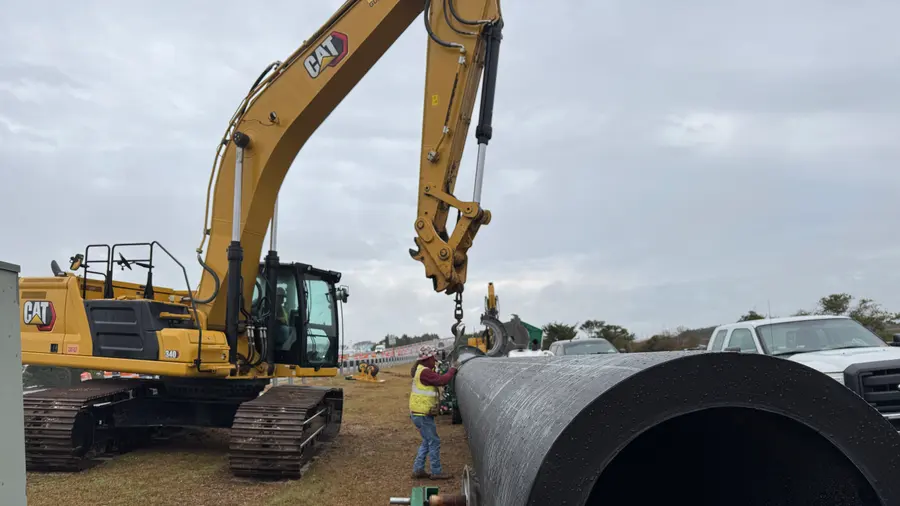
An excavator, sometimes called a track hoe, digs the trench the pipe will sit in. That much is intuitive. What surprises people is how much the choice of bucket or attachment depends on what is actually in the ground.
Normal soil digs at a steady, predictable rate with a standard bucket, and a crew can plan a day’s progress with real confidence. Rock changes that completely. Softer or fractured rock can sometimes be handled with a heavier bucket built for ripping. Harder rock often needs a hydraulic hammer, commonly called a hoe-ram, to break material small enough to remove, and in the most difficult ground a rock saw cuts a controlled line before excavation even starts. We have written separately about trenching through rock if you want the full picture, but the short version here is that the excavator you see on a route is rarely a single, interchangeable machine. It is matched to the geology under that specific stretch of ground.
Sidebooms move pipe without damaging it
The machine that confuses first-time visitors the most is the sideboom: a tracked vehicle with a boom mounted off to one side and a large counterweight on the other, built specifically to carry pipe alongside a trench and lower it in as one continuous, welded string.
A standard crane is not built for this job. Pipe is long, rigid, and already coated by the time it reaches this step, and it cannot be bent, dragged, or set down carelessly without risking the coating or the weld itself. A line of sidebooms works together, each one holding a section of the string at the correct height and angle, moving in careful coordination so the whole assembly settles into the trench evenly rather than twisting or sagging under its own weight. Watching a well-run lower-in is close to watching a single machine with several bodies, because that is effectively what it is.
Boring rigs put pipe where you cannot dig
Not every foot of a pipeline gets an open trench. Roads, railroads, rivers, and sensitive wetlands often cannot be cut open, either because the surface cannot be disturbed or because a permit specifically forbids it. That is where a boring rig comes in, driving or drilling a path underground so the pipe can be pulled through below the obstacle instead of across it.
Horizontal directional drilling is the best-known version of this, steering a drill head along an engineered path and pulling pipe through behind it. Smaller bores under a single road use similar principles at a smaller scale. Either way, the equipment is distinct from anything else on the route, and it depends heavily on engineering done well before the rig ever shows up, since the entry angle, depth, and soil conditions all have to line up on paper first.
Welding, testing, and the equipment nobody photographs
Not every piece of equipment makes for an interesting photo. Welding rigs power the machines that join pipe into a continuous line, and inspection equipment checks every weld before it ever goes into the ground. Later, pumps and gauges fill the finished line with water and hold it under pressure to prove it is sound before anything flows through it. None of this draws a crowd on a site tour, but skipping any of it is not an option. A pipeline is a pressure vessel in the ground, and the equipment that proves it is built right matters as much as the equipment that digs the trench.
The same is true for restoration equipment at the end of a job. Seeding equipment, erosion control materials, and the graders that smooth the right-of-way back to its original contour rarely get mentioned when people describe a pipeline project, yet the land has to be returned to a usable condition before anyone considers the job finished. A crew that treats restoration as an afterthought leaves a visible scar on the route long after the pipe itself is buried and forgotten.
Matching equipment to the step, not stacking it up
- A standard excavator bucket moves at a steady pace in normal soil, while rock calls for a ripping bucket, a hoe-ram, or a rock saw depending on how hard the ground fights back.
- Sidebooms carry and lower welded pipe without damaging the coating, a job a general-purpose crane is not designed to do.
- Boring rigs install pipe underground at crossings where the surface cannot be opened.
None of that list is the point by itself. The point is that every machine belongs to a specific step in the sequence, and a spread only moves as fast as the slowest match between a machine and the ground or task in front of it. A contractor with a large equipment yard is not automatically better equipped for your job. A contractor that can explain which machine goes where on your specific route, and why, has actually thought about the project rather than quoting a generic number.
What this means when you are choosing a contractor
This is also a fair line of questioning to bring into a bid conversation. Ask what equipment a contractor would run on your crossings, your soil conditions, and your schedule, and listen for specifics rather than a general list. That is one of the better questions to ask a pipeline contractor before you sign anything, because the answer tells you whether the bid reflects your actual ground or a template from the last job.
It also matters whether that equipment is run by the contractor’s own people or handed off to a sub for the day. We self-perform across the scope of a job, including the equipment and the crews that run it, because keeping it in-house is how the pace of one step stays matched to the next instead of waiting on someone else’s schedule.
If you are planning a route and want to understand what it will actually take to build it, equipment included, get in touch and tell us about the job. We can walk you through what would show up on your right-of-way and why.
Frequently asked questions
What is a sideboom used for in pipeline construction?
A sideboom is a tracked machine built to carry a welded string of pipe alongside the trench and lower it in as one continuous piece. Its counterweight and boom are designed to hold heavy pipe steady without bending it or damaging the coating, which a standard crane is not built to do.
Why do pipeline crews use a different excavator for different ground?
Soil and rock behave differently under a bucket. Soft or normal ground digs at a steady pace with a standard excavator bucket, while rock often needs a heavier ripping bucket, a hydraulic hammer, or in some cases a rock saw, before the material can even come out of the trench.
What does a boring rig do on a pipeline job?
A boring rig drives or drills a path underground so pipe can be installed beneath a road, railroad, river, or wetland without opening the surface. It is the equipment behind horizontal directional drilling and other trenchless crossing methods.
Does more equipment mean a contractor can build a bigger pipeline faster?
Not by itself. Equipment only helps if it is matched to the step it is doing and crewed by people who run it well. A contractor's real capacity comes from how it organizes spreads and crews, not from the size of its equipment yard.
Should I ask a contractor about their equipment before hiring them?
Yes. Asking what equipment they would bring to your specific crossings, your ground conditions, and your schedule tells you whether they have actually thought through your project, rather than quoting a generic number.