October 27, 2026
What Protects a Pipeline From Corrosion?
How coating, cathodic protection, and the way a line is built and backfilled work together to keep a buried pipeline from corroding over its service life.
Key takeaways
- Coating is the pipe's first line of defense against corrosion, applied before the pipe ever goes in the ground.
- Cathodic protection is a backup electrical system that stops bare steel from corroding wherever the coating has a gap.
- Backfill practice, especially in rock, is what keeps the coating intact before the line is even in service.
- Welds and tie-ins lose factory coating coverage, so they need their own field coating and inspection.
- Monitoring after construction, through test stations and patrols, is how an operator confirms the protection is still working.
A gas utility reviewing an older section of its system does not usually start with the pipe itself. It starts with a question that sounds simple and is not: is this line still protected the way it was designed to be? Corrosion does not announce itself. It works quietly under the ground for years before it shows up as a leak, and by then the conversation has shifted from maintenance to an unplanned repair.
The honest answer is that corrosion protection is not one thing. It is a system, built in layers, and most of those layers get locked in during construction, long before a line ever goes into service. If you are weighing a pipeline construction scope or trying to understand why your contractor cares so much about backfill in rocky ground, it helps to walk through how the whole system actually works. Our glossary has plain definitions for a lot of the terms below, if some of this is new to you.
Coating is the first line of defense
Steel corrodes when it is in contact with soil, moisture, and oxygen at the same time. The simplest way to stop that is to keep the steel from touching any of it, and that is exactly what coating does. Pipe arrives from the mill with a factory-applied coating already bonded to the surface, a barrier layer designed to keep the pipe separated from the ground it sits in for the rest of its service life.
As long as that coating stays unbroken, corrosion has nowhere to start. The steel underneath is sealed off from the electrolyte it needs to corrode, and the pipe can sit in wet, acidic, or mineral-heavy soil without a problem. The entire rest of the corrosion control system exists to cover the gaps that coating alone cannot close, because no coating survives transport, handling, welding, and backfill without a single flaw.
Cathodic protection is the backup system
This is the part most people outside the industry have never heard of, even though it runs under nearly every buried steel pipeline in the country. Cathodic protection is an electrical system that keeps bare steel from corroding wherever the coating has a gap, a scratch, or a pinhole too small to ever find by eye.
The idea comes down to basic electrochemistry. Corrosion happens when steel gives up electrons to its surroundings. Cathodic protection flips that by supplying the pipe with a small continuous current from somewhere else, either sacrificial anodes that corrode in the pipe’s place or a rectifier that pushes current through the ground to the pipe from an external power source. Either way, the steel itself stops being the part of the circuit that corrodes. It becomes the protected side instead.
This is why coating and cathodic protection always get specified together rather than one replacing the other. Coating keeps the current demand low by covering nearly all of the pipe, and cathodic protection picks up the rest. A corrosion control system missing either half is not really a system.
Not the same as concrete weight coating
It is worth clearing up a mix-up that comes up fairly often. The protective coating we are describing here, the thin barrier layer that stops corrosion, is a different scope from concrete coating and weight installation, even though both involve coating pipe.
Concrete weight coating is about buoyancy, not corrosion. Pipe wants to float in wet, marshy, or water-crossing ground, and concrete weights hold it down so it stays where the design put it. A pipe can need both: the thin corrosion coating underneath to keep steel from rusting, and a concrete jacket over the top of that to keep the whole assembly from floating out of the trench. Knowing the difference matters when you are reading a bid package, because the two scopes get priced, inspected, and installed differently, even on the same stretch of pipe.
Construction decides whether the coating survives
Here is the part that surprises people who assume corrosion control is purely an engineering and design question. A lot of it is decided on the ground, during construction, by how carefully the pipe is handled.
Coating gets damaged the same ways any coated surface gets damaged: scraping, impact, and abrasion. Dragging pipe across rough ground, setting it down on sharp debris, or backfilling it against jagged rock can all wear through a coating that looked flawless when it left the mill. The damage is rarely dramatic. It is usually a small gouge or a worn patch that nobody notices at the time, and it sits there as a future corrosion site until something eventually finds it, often a leak survey years later.
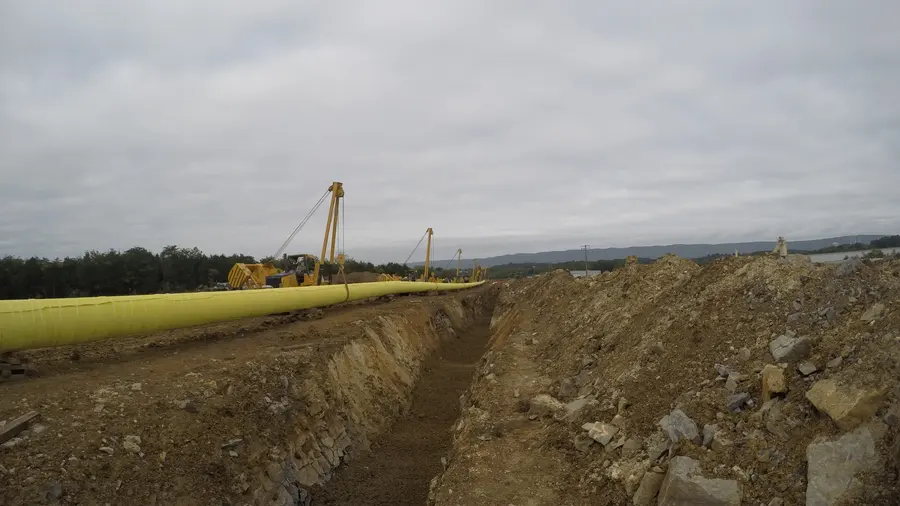
This is exactly why trenching through rock calls for its own discipline. Padding the trench bottom and backfilling with selected material instead of raw spoil keeps sharp rock away from the coated pipe. It is not an extra step tacked onto the schedule. It is part of what makes the corrosion protection designed on paper actually hold up in the ground.
Welds and tie-ins need their own coating
Every pipe arrives with mill-applied coating, and that coating stops short of the ends, because the ends still have to be welded together in the field. That leaves a gap at every single joint on the line, right at the point where two pieces of pipe are permanently joined.
Once a weld is made and passes its inspection, that joint gets its own coating applied in the field, specifically sized to cover the bare steel the mill coating could not reach. Our weld inspection process and the field coating step go together for that reason. A sound weld with no coating over it is still bare steel sitting in the ground, and a well-coated joint over a bad weld does not fix the underlying problem either. Both have to be right, in the right order, before that section of pipe gets backfilled and disappears from view.
Tie-ins carry the same risk on a larger scale, since they are where new pipe connects into an existing system, often with more field welding and more handling in a tighter space. The same rule applies: inspect the weld, then coat the joint, then confirm the coating before anything gets covered back up.
Reading the system after it goes into the ground
A corrosion control system is not something you install once and forget. Operators check it the same way you would check any protective system that is doing invisible work: by measuring whether it is actually working.
Test stations placed along the right-of-way let an operator measure the pipe-to-soil voltage at intervals down the line, which tells them whether the cathodic protection system is still delivering enough current to protect the steel. Periodic surveys and patrols add another layer, catching changes in soil conditions, stray currents from other buried utilities, or anode systems that are wearing down and need attention. None of this replaces the coating or the cathodic protection system. It is how an operator knows those systems are still doing their job years and decades after construction wrapped up.
This is part of why aging infrastructure gets evaluated so carefully before a decision is made to rehabilitate or replace it. The condition of the corrosion control system, not just the age of the pipe, is a big part of what that evaluation is actually measuring.
What this means when you are planning a line
If you are new to buying pipeline work, corrosion control can sound like a detail to leave entirely to the engineer. It is worth understanding at a basic level anyway, because the questions you ask a contractor about it tell you a lot about how carefully they build.
Ask how backfill is handled in rocky or difficult ground. Ask how field joints get inspected and coated after welding. Ask what happens when a coating defect is found before backfill, not just whether one ever is. A contractor who self-performs the construction, rather than handing coating and backfill off to whoever is cheapest that week, has a direct stake in getting those steps right the first time, because there is no one else to blame later if the line does not hold up.
Corrosion control is not a single product you buy. It is a set of decisions made across engineering, construction, and the decades of operation that follow, and most of the ones that matter most get made with a crew standing in a trench, not in a design office. That is worth remembering the next time someone tells you backfill is just backfill.
If you are planning a new line or trying to understand how a section of your system is holding up, get in touch and tell us what you are working with. We can walk through what good corrosion protection looks like at every stage, from the pipe mill to the ground it ends up in, and request a bid when you are ready to move.
Frequently asked questions
What is cathodic protection on a pipeline?
Cathodic protection is an electrical system that keeps buried steel from corroding. It pushes a small protective current onto the pipe, either from sacrificial anodes or a rectifier, so the steel itself is not the part of the circuit that gives up electrons and corrodes. It works alongside the coating rather than instead of it.
How does pipeline coating prevent corrosion?
Coating is a barrier that keeps the steel pipe separated from the soil and the moisture in it. As long as the coating stays intact, oxygen and electrolytes cannot reach the steel and corrosion has nothing to start on. Coating is the main defense, and cathodic protection is the backup for the spots the coating does not reach.
Why does rocky backfill matter for corrosion protection?
Sharp rock backfilled directly against coated pipe can gouge or wear through the coating, sometimes without anyone seeing it happen. A single bare spot gives corrosion a place to start years before anyone would otherwise suspect a problem, which is why padding and careful backfill in rocky ground matter as much as the coating itself.
Are welds and tie-ins more vulnerable to corrosion?
Yes. The mill coating a pipe arrives with stops short of the weld joint, so every field weld and tie-in needs its own coating applied and inspected after the weld passes. Skipping or rushing that step leaves bare steel at exactly the points where two pieces of pipe come together.
How is corrosion protection monitored after a pipeline is built?
Operators use test stations along the route to measure the pipe-to-soil voltage and confirm the cathodic protection system is still delivering current, along with periodic patrols and surveys over the life of the line. That monitoring is what turns a corrosion control system from a one-time installation into something an operator can trust for decades.